2025 marked a year of progress for the diabetes community, driven by collective advocacy and strong collaboration across many stakeholders to improve the lives of people with diabetes (PwD) and those at risk. With the election of a new IDF Europe Board and a refreshed vision and mission, we have strengthened our commitment to transforming life with diabetes through innovation, leaving no-one behind.
Across a wide range of activities, several themes have stood out in our work — particularly those reflecting the need for more joined-up health policies, equitable access to innovation and the inclusion of lived experience in decision-making.
Raising awareness of the interconnectedness between diabetes and other chronic conditions and the resulting need for coordinated prevention and management, and strengthening advocacy on this theme have been
key priorities for IDF Europe, particularly in the context of the EU Cardiovascular health (CVH) plan.
Improving access to medicines, technologies and treatments including innovative medicines and solutions to support diabetes management has also been a key area of work this year. As digital health tools such as continuous glucose monitors (CGMs) play an increasingly central role in daily diabetes management and innovation in diabetes technologies accelerates, ensuring that these technologies are safe, reliable and fit for purpose remains essential. Throughout 2025, IDF Europe contributed to discussions on the EU Medical Devices Regulation, highlighting the need for clear and consistent standards that protect PwD and support high-quality innovation.
The year also underscored the importance of engaging young people with lived experience in shaping diabetes policy. Through our Youth Leadership Lab, as well as targeted opportunities including the Youth Policy Dialogue at the European Commission, members of our YOURAH network engaged directly with European Commissioners and Members of the European Parliament (MEPs), to raise awareness of the links between diabetes and mental health. These exchanges reinforced
the importance of meaningfully engaging lived experiences in decision-making, addressing inequalities in access to care and strengthening healthcare systems so they better respond to real world needs.
We also remained actively engaged with WHO Europe, including by submitting statements at the 75th session of the WHO Regional Committee for Europe on the importance of ensuring the well-being of all PwD across the life
course, the need to harness innovation in diabetes care and to improve the prevention and control of non-communicable diseases (NCDs) across the entire European region. In parallel, we worked on the development of the Political Declaration of the fourth high-level meeting on the prevention and control of NCDs and the promotion of mental health and well-being. Working closely with our Member Associations, we advocated for the integration of ambitious NCD targets in the Declaration and for the meaningful engagement of people with lived experience in shaping policies.
These examples represent only a snapshot of our work in 2025, but together they illustrate our commitment to advocacy, innovation and empowerment.
Looking ahead to 2026, we will continue to advance diabetes prevention and early detection, while promoting improved access to medicines, technologies and high-quality care across Europe.
Together, we look forward to another year of progress through collaboration and advocacy – to a future where all PwD and those at risk can thrive.
YOUTH PLATFORM
Apply to host the 2026 Youth Leadership Lab
Would you like to play a role in uniting and strengthening the voices of young diabetes advocates across Europe? We are now welcoming applications from our Member Associations to host the 2026 IDF Europe Youth Leadership Lab.
The Youth Leadership Camp, now Youth Leadership Lab (YLL), is an IDF Europe long-standing initiative designed
to nurture a new generation of diabetes advocates and build a strong, pan-European youth network.
Each year, around 24 advocates aged 18-30 from IDF Europe Member Associations take part in the YLL, which includes a series of online workshops followed by an in-person camp. The 2026 in-person camp will take place from July 5 to 11.
If your Member Association is interested in hosting the next edition of the YLL, please complete the application form by January 31.
IDF Europe expert day: “From detection to cure – transforming lives for people with diabetes”
On December 4, IDF Europe held an Expert Day in Brussels, bringing together PwD, healthcare professionals (HCPs), researchers, policymakers and other experts to explore how innovation is transforming diabetes prevention, early detection and care. Discussions focused on type 2 diabetes (T2D) remission, the interplay between dysglycaemia and cardiovascular, kidney and liver diseases and advances in cell and gene therapies.
Thank you to all of our speakers, presenters and attendees for supporting us during this event!
Read more about the Expert Day in the event report and in the Op-Ed in The Parliament Magazine by Martina Boccardo, IDF Europe’s Strategic Communications and Content Coordinator.
During the summit, Kostas presented his perspectives as a person living with both diabetes and cardiovascular disease (CVD). He highlighted the need for coordinated care among various specialists involved in managing diabetes, CVD and obesity; including a dedicated care coordinator to support individuals in navigating complex care pathways; and access to psychological and peer to peer support.
IDF Europe at the
“Bridging the Gap”
Meeting in Budapest
IDF Europe was pleased to be represented by IDF Europe Chair-Elect, Prof. João Raposo, and Regional Manager, Elisabeth Dupont, at the “Bridging the Gap” event in Budapest, gathering advocates and experts across diabetes, obesity, CVD, liver and kidney conditions to explore how prevention and care for people living with, or at risk of multiple long-term chronic conditions can be better integrated.
Discussions highlighted the urgent need to break down silos and develop truly connected approaches that reflect the interplay between these conditions. We
thank ECPObesity for hosting this important event.
IDF Europe mobile health unit event report
From November 12–14, IDF Europe’s Mobile Health Unit was stationed outside the European Parliament (EP) in Brussels, where 175 participants received tests for blood pressure, cholesterol, blood glucose and BMI, along with guidance and information on their risk for diabetes, CVD and obesity.
We were pleased to welcome several MEPs including Adam Jarubas, Romana Jerković, Peter Agius, Elena Nevado Del Campo, Laurent Castillo and Manuela Ripa, who joined us in supporting health awareness and early detection.
World Diabetes Day 2025: women’s health event report
IDF Europe’s World Diabetes Day 2025 event report is now available. On November 13, we held an event “Towards a sex- and gender-sensitive strategy in diabetes: understanding women’s health across the life course” at the EP in Brussels, co-hosted by MEP Paulo do Nascimento Cabral and MEP Sirpa Pietikäinen.
The event highlighted the gaps in care experienced by women living with diabetes and outlined steps to effectively embed sex- and gender-sensitive approaches in diabetes care, research and policy.
The sound of diabetes: young voices at the European Parliament
On 12 November, IDF Europe marked World Diabetes Day with “The Sound of Diabetes”, its first-ever youth-led event at the EP Entirely co-created and designed by young people living with type 1 diabetes (T1D), the event placed their lived experiences at the centre of discussions on mental health and well-being.
Hosted by MEP Peter Agius, the event brought together young people, health experts and policymakers for three panel discussions focused on the need for mental health and psychological support, stigma and discrimination in schools and the workplace, and the role of sport in supporting mental and physical health. The event underscored the importance of meaningfully involving young people in shaping policies and support systems that affect their lives.
IDF Europe Advocate Award 2025: interviews are out!
This year, as part of World Diabetes Day 2025, IDF Europe awarded its Advocate Prize to two advocates Davor Skeledžija and Marcello Grussu, who have made exceptional contributions to improving the lives, rights and care of PwD in their respective countries.
More information about their work can be found in their interviews:
Davor Skeledžija – driving structural change in diabetes care
IDF Europe response
to UN Political Declaration
on NCDs
IDF Europe has published a reflection on the UN Political Declaration adopted at the fourth High-Level Meeting on the prevention and control of NCDs. While the Declaration includes several welcome steps, such as new fast-track targets and a strong focus of equity and primary care, IDF Europe remains concerned that it falls short in addressing the growing burden of NCDs.
Upcoming webinar: Horizon Europe opportunities for diabetes research
IDF Europe, in collaboration with Breakthrough T1D, will host a webinar on January 20 exploring the new calls under the Horizon Europe Work Programme 2026–2027. The session will present upcoming funding opportunities to accelerate innovation in diabetes care and provide a platform for researchers, innovators and stakeholders to connect and explore potential collaborations.
The Georgian Union of Diabetes and Endocrine Associations celebrated the 33rd World Diabetes Day at the National Library of Georgia, bringing together PwD, HCPs, policymakers and industry partners. The event highlighted the country’s progress in diabetes care, from ensuring free insulin for all in need to providing sensors for children and adolescents with T1D. Young PwD also shared their experiences and spoke to leading TV channels.
With participation from the Minister of Health, Members of Parliament and pharmaceutical companies, the event underscored that by working together, Georgia can continue advancing access to care and improving quality of life for PwD.
Human Rights Day:
ensuring the right
to health for PwD
Human Rights Day reminds us that health is a fundamental right. Yet, many PwD across Europe still struggle to access early diagnosis, affordable medicines and technologies. These gaps are often shaped by social determinants such as low income, insecure employment, limited education, food insecurity, social exclusion, inter-generational trauma and poor housing.
IDF Europe works with partners and policymakers to strengthen prevention and early detection, expand access to integrated care and ensure that the voices of PwD guide the
development of effective policies upholding the right to health for all.
International Migrants Day: leaving no one behind in diabetes care
On International Migrants Day, we highlight the urgent need to ensure that migrants and displaced PwD have equitable access to care. Disruption during displacement, systemic barriers in host countries and social determinants such as discrimination, language and cultural differences, legal status and poverty all limit access to early diagnosis, essential medicines and person-centred care.
IDF Europe is committed to supporting uninterrupted access to diabetes care, addressing social determinants of health and amplifying the voice of people with lived experience to shape inclusive and equitable health
policies.
Universal Health Coverage Day: closing the gaps in diabetes care
On Universal Health Coverage (UHC) Day, we highlight that no one should be denied the care they need because of cost, geography or other circumstances. Yetfor many PwD across Europe, access to screening, early diagnosis, essential medicines and the right support remain uneven.
On UHC Day, we call for renewed commitment to turning the right to health into reality for all PwD and those at risk.
Human Solidarity Day:
united for diabetes
care
On Human Solidarity Day, we celebrate the power of collective action to ensure that all PwD have access to the care and support they need. Solidarity drives health equity — no one should be left behind.
IDF Europe works with partners, policymakers and communities to strengthen integrated, person-centred care, amplify the voices of PwD and advance policies that make high-quality care accessible to all.
READINGS ON DIABETES
Readings on Diabetes, presented to IDF Europe by Angelo Argenteri, MD, Maria Stella de Sabata, MA, and Andrea Ascoli Marchetti, MD, is a journey through the major diabetes milestones, one of the oldest and still most widespread diseases, with anecdotes, stories, historical facts and a very rich iconography.
Each month, the IDF Europe Newsletter presents a chapter from Readings on Diabetes, which can be downloaded in full here.
10. Claude Bernard and the dawn of modern diabetology
Chapter Ten takes us into 19th-century Paris, where Claude Bernard (1813–1878) emerged as one of the defining figures in modern biomedical science. Often called the father of experimental medicine, Bernard helped shift medicine from observation to rigorous biological investigation.
Raised in rural Beaujolais and originally aspiring to be a playwright, he arrived in Paris almost by accident — only to revolutionise physiology. Under François Magendie, he championed controlled experimentation and intellectual independence, attracting students, social elites and
international acclaim. Challenging the belief that animals could not produce organic substances, Bernard showed that the liver manufactures glucose and introduced the groundbreaking concept of “internal secretions.” His “washed liver” experiments revealed glycogen, while his studies on “artificial diabetes” demonstrated how nervous system injury could induce hyperglycaemia.
This chapter paints a vivid portrait of a scientific revolution — and of Bernard’s pivotal role in laying the foundations for modern diabetology. Discover the full story in Chapter Ten of Readings on Diabetes.
Are you curious to learn about the long quest to understand diabetes? Explore this fascinating story in Chapter Ten of Readings on Diabetes
IDF Europe podcast on integrated care published in MEJ journal
We are delighted that our podcast episode on integrated diabetes care is now published in the Multidisciplinary Health and Wellbeing (MEJ) journal, with the transcript translated into Hungarian. A big thank you to JACARDI for helping bring this important conversation to a wider audience. The podcast episode features Dr. Benedetta Armocida, Coordinator of JACARDI, the EU Joint Action on CARdiovascular and Diabetes, and Dr. Helena Safadi, Leader of the JACARDI Work Package 9 on Integrated Care Pathways. They both discuss what integrated care really
looks like in practice, why it is so important for people living with chronic conditions like diabetes and the main challenges to scaling up innovation across health systems. Read the article here or listen to the podcast here
WHO releases first global guideline on GLP-1 therapies
The WHO has published its first global guideline on the use of Glucagon-Like Peptide-1 (GLP-1) therapies for treating obesity. This follows its 2025 decision to add GLP-1 medicines to the Essential Medicines List for managing T2D in high-risk groups. The guideline includes two conditional recommendations. GLP-1 receptor agonists or GIP/GLP-1 dual agonists may be considered as long-term treatment for adults living with obesity, and intensive behavioural therapy may be used alongside these medicines as part of a comprehensive clinical approach. The WHO stresses that expanding access in a fair and affordable way is essential to avoid widening existing health inequalities. Read more
IDF Europe supports EPHA’s call to protect the 2035 ICE phase-out
IDF Europe welcomes and supports the European Public Health Alliance’s (EPHA) continued efforts to safeguard the EU’s 2035 phase-out of internal combustion engines (ICE). This policy is a critical step toward reducing air pollution, a major environmental determinant of health. Exposure to pollutants from road transport is strongly linked to a range of chronic conditions, including diabetes. Long-term PM₂.₅ exposure is estimated to contribute to around one- fifth of global T2D cases, while air pollution has also been
associated with increased risk of gestational diabetes. Protecting the 2035 ICE phase-out is therefore essential for improving public health outcomes and reducing the burden of chronic disease across Europe. Read more
EU RESEARCH PROJECTS
Sports & Diabetes: Digital Peer Support (DiaPs)
IDF Europe is part of the Erasmus+ project Sports & Diabetes: Diabetes Digital Peer S(up)port (DiaPs), which is developing an app for peer support where PwD can share their experience of managing their condition during sport activities.
In preparation for the app release, DiaPs is sharing content on social media featuring practical tips, myth-busting posts and insights from athletes living with diabetes.
We are proud of being part of the DigiCare4You Horizon 2020 project which aims to improve the early prevention and management of T2D and hypertension (HTN) through the integration of social and healthcare systems, supported by digital tools.
First-year results presented at international congress
In early December, DigiCare4You Project Coordinator, Professor Yannis Manios, presented results from the first year of the DigiCare4You intervention at the 18th Hellenic Congress of Nutrition & Dietetics in Athens, Greece. The presentation highlighted both the effectiveness and cost-effectiveness of this EU-funded Horizon 2020 project in supporting the prevention and management of T2D and HTN. These findings contribute to the growing evidence base on digital, person-centred approaches to chronic disease care across Europe.
As part of the EU-funded DigiCare4You project, a new interview highlights the development of digital tools designed to support the early prevention and management of T2D and HTN. In the interview, Sandro Girolami, co-founder of METEDA SRL explains how these person-centred digital solutions are adapted to local contexts in Albania, Bulgaria, Greece and Spain, helping to better integrate social and healthcare systems and improve access to care.
The fifth edition of the DigiCare4You newsletter was published this month. The newsletter provides an overview of the project and the first glimpse into its preliminary results.
Subscribe here to receive the DigiCare4You newsletter
MMD NEWS
The MMD Group welcomes three new MEPs!
The MEP Interest Group on Diabetes – MEPs Mobilising for Diabetes (MMD) aims to represent the interests of PwD, their relatives and carers as well as those at risk by elevating diabetes on the public agenda and fostering key policy changes in Europe. The MMD group is delighted to welcome three new members: MEPs Paulo Do Nascimento Cabral, Sebastian Everding and Michalis Hadjipantela.
MEP Paulo Do Nascimento Cabral
The MMD Group is also delighted to welcome MEP Paulo Do Nascimento Cabral (EPP. Portugal) as a new member. He serves as Vice-Chair of the Delegation for Relations with South Africa (D-ZA), and is a member of the Committees on Agriculture and Rural Development (AGRI), Fisheries (PECH), the Delegation for Relations with the United States (D-US) and the Parliamentary Assembly of the Union for the Mediterranean (DMED).
The MMD Group is delighted to welcome MEP Sebastian Everding (The Left, Germany) as a new member. He serves as Vice-Chair of the Delegation to the EU-Albania Stabilisation and Association Parliamentary Committee (D-AL) and is a member of the Committees on Agriculture and Rural Development (AGRI) and Delegation for relations with Bosnia and Herzegovina and Kosovo (DSEE). He is also a substitute member of the Committees on Environment, Climate and Food Safety (ENVI), Public Health (SANT) and Fisheries (PECH).
The MMD Group is delighted to welcome MEP Michalis Hadjipantela (EPP, Cyprus) as a new member. MEP Hadjipantela serves on the Committee on Economic and Monetary Affairs (ECON), the Committee on Public Health (SANT), the Subcommittee on Tax Matters (FISC) and the Delegation for Relations with Iran (D-IR). He is also a substitute member of several committees, including Budgets (BUDG), Environment (ENVI), and Industry, Research and Energy (ITRE).
Each year, November 14 marks World Diabetes Day (WDD) – a key opportunity to unite our community, raise awareness of diabetes across Europe and advocate for the policies needed to ensure that everyone living with, or at risk of, diabetes can live long, healthy and fulfilling lives.
Despite continued advances in care, significant unmet needs remain. Too many people still face barriers to early detection and screening, access to medicinesandtechnologies and integrated care for diabetes and its related
complications such as cardiovascular disease (CVD). This year, inspired by our vision “From early detection to cure – transforming life with diabetes through innovation, leaving no one behind”– we reaffirmed our commitment to improving access to quality care, and strengthening the voices of people living with diabetes (PwD).
Throughout Diabetes Awareness Month 2025, IDF Europe organised a series of initiatives to highlight our key priorities. These activities included a social media campaign outlining our main key messages, our mobile health unit in Brussels offering free blood glucose testing and two events at the European Parliament (EP), gathering members of your YOURAH network, healthcare professionals (HCPs), policymakers, researchers and people with lived experience. Together, these initiatives aimed to drive meaningful discussions and advance efforts to improve diabetes care across Europe.
Continue reading our November newsletter to discover more about our activities and diabetes-related news from Europe.
OUR WORLD DIABETES DAY INITIATIVES
MEPs join us in celebrating WDD
On the occasion of WDD, several Members of the EP (MEPs), including members of the MEP Interest Group on Diabetes, MEPs Mobilising for Diabetes (MMD), joined our events and initiatives at the EP and shared video messages to raise awareness of diabetes and highlight the need for stronger policy action.
We extend our sincere thanks to all the MEPs who supported our activities: Peter Agius, Paulo Do Nascimento Cabral, Laurent Castillo, Sunčana Glavak, Adam Jarubas, Romana Jerković, Billy Kelleher, Elena Nevado del Campo, Sirpa Pietikäinen and Manuela Ripa. Their engagement helps call for stronger policy action at both EU and national levels to improve health outcomes and quality of life for PwD and those at risk.
“The sound of diabetes” – youth voices at the European Parliament
On November 12, IDF Europe and our YOURAH network brought together young diabetes advocates, HCPs and policymakers to “The sound of diabetes”, an event hosted by MEP Peter Agius at the EP. The session highlighted the lived experiences of young people with type 1 diabetes (T1D) and demonstrated the powerful impact their voices can have in political spaces.
Through three panel discussions, the participants explored the mental health burden of T1D, the stigma and discrimination faced in schools and workplaces, and the role of sport in supporting both mental and physical well-being. The conversations underscored the urgency of integrating mental health into standard diabetes care, promoting inclusion in work and educational settings and ensuring that support systems meet PwD’s needs.
We thank MEP Agius, all speakers and youth advocates for their insights, experiences and calls to action.
“Towards a sex- & gender-sensitive diabetes
strategy”
On November 13, IDF Europe held an event at the EP co-hosted by MEPs Paulo Nascimento Cabral and Sirpa Pietikäinen, focusing on the challenges faced by women living with diabetes and the urgent need for sex- and gender-sensitive approaches in care, research and policy.
The event opened with powerful testimonials and presentations from diabetes advocates and HCPs, who highlighted how current diabetes care and technologies often fail to meet women’s needs. They pointed to the underrepresentation of women in research,
limited funding for studies exploring sex- and gender-specific differences, and limited knowledge from HCPs on women’s health.
Following this was a panel discussion addressing the need for dedicated funding, stronger education for HCPsand PwD, and innovations reflecting women’s needs. Panellists also stressed the importance of embedding women’s health across all EU policies.
“Know your numbers”: IDF Europe mobile health unit
From November 12 to 14, IDF Europe set up a Mobile Health Unit in front of the EP in Brussels, providing free health checks to help visitors understand their risk of diabetes, CVD and obesity.
Throughout the event, 180 people had their HbA1c, lipid levels, blood pressure and other key indicators measured. Participants were eager to learn more about their numbers and received on-site guidance and education from HCPs.
This initiative aimed to raise awareness of diabetes and its related conditions as well as to underscore the importance of screening, early detection and timely treatment to support effective management and reduce the risk of serious complications.
IDF Europe’s Director of Strategy and Policy, Sabine Dupont led a panel on the lived experience of managing T1D alongside CVD. Panellists highlighted the emotional and physical challenges, the gaps in tailored support and the limited awareness among HCPs of the interaction between the two conditions and ways to address it.
On November 14-16, IDF Europe attended the Global Parliamentary Diabetes Advocacy Forum, organised byParliamentarians for Diabetes Global Network (PDGN) in Malta, where policymakers from around the world discussed strategies to improve diabetes prevention, early detection and care.
IDF Europe Board Members, Dr. Sufyan Hussain and Prof.
João Raposo, made presentations on the role of advocacy and the early detection of T1D, respectively. The meeting concluded with the Valletta Call to Action, a policy document outlining key priorities for governments to strengthen diabetes care worldwide.
IDF Europe Advocate Award 2025:
celebrating outstanding diabetes advocacy
As part of WDD 2025, IDF Europe proudly announced the recipients of this year’s Advocate Awards. Supported by Lilly, the award recognises individuals who have made exceptional contributions to improving the lives, rights and care of PwD across Europe. Below, we highlight the inspiring work of our two 2025 awardees: Davor Skeledžija and Marcello Grussu.
Davor Skeledžija – driving structural change in diabetes care
Diagnosed with T1D at age 13, Davor has been working with local and national diabetes associations to expand the reimbursement of diabetes medicines and continuous glucose monitors for people living with T1D and type 2 diabetes (T2D) in Croatia, improving equity and affordability of care.
He also
played a key role in campaigns to remove discriminatory regulations that prevented people on insulin therapy from obtaining professional driving licenses, advancing equal employment opportunities.
Marcello Grussu – advancing PwD rights through sport
Diagnosed with T1D in 1986, Marcello Grussu has spent decades proving that diabetes is not a barrier to achievement. As President of ANIAD (Italian National Association of Athletes with Diabetes), he has championed the transformative role of sport in diabetes management, prevention and social inclusion.
Marcello is also a committed advocate for the rights of PwD in Italy, fostering collaboration between institutions, scientific societies and diabetes associations to strengthen care and awareness.
Interviews with Davor and Marcello will be released soon!
Blood glucose testing activities during Diabetes Awareness Month
Each year, during Diabetes Awareness Month, IDF Europe organises blood glucose testing events at several EU institution buildings to raise awareness of diabetes, its risk factors and the importance of screening and early detection to reduce the risk of serious complications. This year, we organised six testing events, and tested a total of 620 people.
The events once again proved highly impactful, creating opportunities for informative discussions about diabetes and managing its risk.
YOUTH PLATFORM
Diabetes and mental health: the 2025 YOURAH Forum
On November 11-13, 20 young diabetes advocates from the IDF Europe YOURAH network met in Brussels for the annual YOURAH Forum, an opportunity for our Youth Leadership Labalumni to reconnect and engage in shared advocacy
efforts.
Over three days, under the theme, “Diabetes and Mental Health”, participants explored the emotional burden of diabetes, stigma and discrimination, and the importance of mental well-being for effective self-management and advocacy.
Would you like to play a role in uniting and strengthening the voices of young diabetes advocates across Europe? We are now welcoming applications from our Member Associations to host the 2026 IDF Europe Youth Leadership Lab.
The Youth Leadership Camp, now Youth Leadership Lab (YLL), is an IDF Europe long-standing initiative designed
to nurture a new generation of diabetes advocates and build a strong, pan-European youth network.
Each year, around 24 advocates aged 18-30 from IDF Europe Member Associations take part in the YLL, which includes a series of online workshops followed by an in-person camp. The 2026 in-person camp will take place from July 5 to 11.
If your Member Association is interested in hosting the next edition of the YLL, please complete the application form by January 31.
Every year, national diabetes associations mark WDD with a wide range of inspiring initiatives. From awareness campaigns, health checks and exhibitions to sports events, activities in schools and workplaces, and lighting landmarks in blue, their efforts play a key role in raising awareness of diabetes and reminding policymakers and the public that more needs to be done to improve the lives of PwD and those at risk.
Blue lights and community strength across Slovenia
Throughout November, the Slovenian Diabetes Association organised nationwide activities promoting physical activity, prevention and awareness, including community challenges, local celebrations and blue illuminations of buildings across the country.
Kazakhstan strengthens diabetes prevention and foot care
To mark WDD, the Diabetes Association of the Republic of Kazakhstan offered foot examinations for PwD and training sessions for endocrinologists to support the prevention and management of diabetes foot complications.
Italy unites communities for diabetes awareness and prevention
Across Italy, IDF Europe Members, FeSDI and ANIAD, together with policymakers, other diabetes associations and public institutions organised a wide range of activities, from sporting events to roundtable discussions to raise awareness of diabetes, promote prevention and
celebrate WDD.
Germany celebrates with science and awareness in action
DiabetesDE marked WDD with scientific exchange and public outreach, including their “Meilensteine der Diabetologie” Congress highlighting the latest development in diabetes care and a TV programme reaching over one million viewers.
A day of diabetes screening, education and blue lights in Cyprus
The Cyprus Diabetic Association marked WDD with nationwide blood glucose and blood pressure testing, awareness initiatives, educational seminars for HCPs on diabetes prevention and care, a marathon and public buildings illuminated in blue.
Over the past year, the Hellenic Diabetes Federation (ELODI) ran a series of initiatives to raise awareness of diabetes and support PwD across Greece.
As part of a nationwide campaign on diabetes-related complications, ELODI developed educational materials on prevention and management, distributed through clinics, public events and community sessions.Two youth-focused initiatives were also developed: “Blue on sail,”a sailing activity for young adults living with T1D, and “Champions in action – diabetes without limits”, a campaign showcasing athletes living with T1D to challenge stigma.
IDF Europe calls for stronger EU standards for continuous glucose monitors
Accurate continuous glucose monitoring (CGM) is essential for PwD, yet recent concerns over the performance of some CE-marked devices highlight gaps in current EU oversight.
To ensure safety and reliability, IDF Europe has been advocating for improvements to the Medical Devices Regulation (MDR), including clear, EU-wide criteria for assessing CGM accuracy and effectiveness. To support its Members, IDF Europe has also developed a two-page document explaining how CGMs are currently assessed in the EU, outlining the main challenges, guiding them on how to report adverse events to national authorities and summarising the key features that high-quality CGMs should meet.
Panel discussion on early detection & better care for heart failure
On November 18, IDF Europe Regional Manager, Elisabeth Dupont, took part in a High-level Panel Discussion at the EP, titled “Early detection, better care: heart failure as a priority in the EU Cardiovascular Health Plan,”hosted by MEP Romana Jerković and organised by the Heart Failure Policy Network.
During the event, Elisabeth
highlighted the interconnected nature of non-communicable diseases (NCDs) and the heightened CVD risk for PwD. She called for improved screening for heart failure in higher-risk populations, systematic CVD risk assessments in diabetes care, timely treatment according to clinical guidelines and person-centred, integrated, multidisciplinary care models.
The European
Patients’ Forum
Congress
On November 26-27, IDF Europe Regional Manager, Elisabeth Dupont, and Director, Strategy & Policy, Sabine Dupont, attended the European Patients’ Forum (EPF) Congress, the largest European event dedicated to the involvement of people with lived experience in healthcare, policy and research.
The event provided a unique platform for dialogue, collaboration and advocacy to promote
resilient, inclusive and person-centred healthcare systems. For our community, it provided an opportunity to highlight the needs of PwD within key discussions and to strengthen connections with other health-related organisations.
The three-day conference will bring together leading health experts to discuss the latest evidence, landmark studies and updates to clinical practice guidelines across internal medicine.
As part of the Annual Update in Diabetology session, IDF Europe Board Member, Prof. Leszek Czupryniak, will make a presentation on treatment options for people living with prediabetes.
Readings on Diabetes, presented to IDF Europe by Angelo Argenteri, MD, Maria Stella de Sabata, MA, and Andrea Ascoli Marchetti, MD, is a journey through the major diabetes milestones, one of the oldest and still most widespread diseases, with anecdotes, stories, historical facts and a very rich iconography.
Each month, the IDF Europe Newsletter presents a chapter from Readings on Diabetes, which can be downloaded in full here.
9. The age of diabetes enlightenment: Marabelli, Frank and the birth of diabetes inspidius
Chapter Nine takes us into the late 18th century, where scientific curiosity and hospital reforms transformed how diabetes was understood. At the heart of this shift stands Francesco Marabelli (1761–1846), a young chemist from Pavia whose collaborations with the renowned Bavarian clinician Johann Peter Frank helped usher in a new era of diagnostic insight.
Working in the San Matteo Hospital pharmacy, Marabelli recognised the need for a more rational, evidence-driven pharmacopoeia. His analyses of urine samples in 1788 led to a key distinction: not all polyuria was the same. Some urine was sweet – characteristic of diabetes mellitus – while other cases involved abundant but tasteless, “insipid” urine.
Building on Marabelli’s observations, Frank described seven cases in his De curandis and formally differentiated diabetes mellitus (“diabetes verus”) from diabetes insipidus, marking the first clear diagnostic separation of the two conditions. Frank even succeeded in crystallising sugar from the urine of people with diabetes mellitus using alcoholic fermentation – an early diagnostic test long before laboratories existed.
This chapter offers a vivid glimpse into the Age of Enlightenment, showing how chemistry, clinical observation and system-wide health reforms converged to deepen our understanding of diabetes and its many forms.
Are you curious to learn about the long quest to understand diabetes? Explore this fascinating story in Chapter Eight of Readings on Diabetes.
EMA releases new booklet on medicine safety in the EU
The European Medicines Agency (EMA) has published a new booklet,‘From laboratory to patients – how the safety of medicines is ensured in the EU’. The report provides an accessible overview of how EU Member States work together to evaluate and monitor medicines,implement risk-minimisation measures and ensure clear communication about potential risks.
The publication also highlights the critical role of experts, patients and HCPs in strengthening medicine safety and maintaining trust in treatments.
The EMA‘s human medicines committee, the CHMP, has recommended a new therapy that can delay the onset of stage 3 T1D in adults and children aged 8+ with stage 2 T1D. The treatment works by slowing the immune-mediated attack on beta cells and is administered as a 14-day course of daily intravenous infusions.
The CHMP opinion is an intermediary step and will now be sent to the
European Commission for a decision on EU-wide marketing authorisation. Once authorised, pricing and reimbursement decisions will be made by each Member State.
IDF Europe is part of the Erasmus+ project Sports & Diabetes: Diabetes Digital Peer S(up)port (DiaPs), which aims to develop an app for peer support where PwD can share their experience of managing their condition during sport activities.
In preparation for the app release, DiaPs is sharing content on social media featuring practical tips,
myth-busting posts and insights from athletes living with diabetes.
We are proud of being part of the DigiCare4You Horizon 2020 project which aims to improve the early prevention and management of T2D and hypertension through the integration of social and healthcare systems, supported by digital tools.
New educational
resources for WDD
As part of the ongoing efforts to strengthen early prevention and awareness, and to celebrate WDD, DigiCare4You released a new video explaining the mechanisms behind T2D.
Albanian-language educational video on hypertension
To broaden access to clear and reliable information to a wider audience, the DigiCare4You educational video on hypertension has now been translated into Albanian.
DigiCare4You process evaluation plan and tools at the participant level
Implementation and process evaluations are an integral part of health intervention trials. To assess the effectiveness of the DigiCare4You solution at the participant level, a process evaluation plan and tools were developed based on the changes found between baseline, 12 and 24-month follow-ups in clinical indices including various blood measurements, blood pressure, anthropometric values and self-reported quality of life.
TRANSFORMING LIFE WITH DIABETES – LEAVING NO ONE BEHIND
Each year on November 14 we mark World Diabetes Day (WDD) – an opportunity to celebrate our community and bring people together to raise awareness of diabetes and advocate for better prevention, care and support, reflecting on the progress still needed to ensure that everyone living with diabetes can live long, fulfilling lives.
Despite continued advances in diabetes care, many unmet needs persist. One in three people living with diabetes (PwD) remain undiagnosed, access to new therapies and technologies is unequal across countries and too
often opportunities for early detection and prevention of diabetes and its complications are missed. Additionally, the strong link between diabetes, cardiovascular disease (CVD), obesity and other chronic conditions, highlights the need for shared solutions to tackle their common risk factors and provide effective treatment and support.
This WDD, IDF Europe is joining forces with partners, PwD, healthcare professionals (HCPs) and policy makers to celebrate the day through a series of events and initiatives inspired by our new vision: “From early detection to cure – transforming life with diabetes through innovation, leaving no one behind”. Together, we will explore
key topics including mental health, the unique needs of women living with diabetes, prevention, early detection and the connections between diabetes, obesity and CVD. We will also highlight the importance of ensuring uninterrupted access to medicines and technologies, revamping our healthcare systems and advancing research into unmet needs in diabetes including its causes, progression and long-term impact.
Continue reading our October newsletter to explore our WDD activities, learn more about our work and join us in raising awareness of diabetes.
YOUTH PLATFORM
The sound of diabetes
Members of our YOURAH network of young diabetes advocates created the video “The Sound of Diabetes,” which shines a light on the everyday challenges faced by young PwD. Through moments captured from their daily lives, the video highlights the impact of diabetes on mental health and the challenges they navigate each day.
The message at the heart of this video will be explored during an event co-designed with YOURAH members, which will take place on November 12 at the European Parliament in Brussels and online.
Highlights from the Slovenian Diabetes Association
Over the past few months, the Slovenian Diabetes Association organised a series of events bringing together healthcare professionals (HCPs), PwD and the public to raise awareness of diabetes, promote healthy lifestyles and advocate for improved diabetes care.
From the ‘Alojz Rudolf Memorial Hike’ to the ‘Sweet Forum – My Sweetest Victory’ and the youth-focused ‘Live a Sweet (Life)!’ programme, these events showcased the power of movement, knowledge and community in fostering a healthier society.
Polish Senate Health Committee meeting on diabetes care
On October 23, IDF Europe took part in a meeting of the Polish Senate Health Committee on access to continuous glucose monitoring (CGM) for PwD, alongside members and representatives of its Member Associations, the Polskie Stowarzyszenie Diabetykow and the Polskie Towarzystwo Diabetologiczne.
Sabine Dupont, IDF Europe’s Director of Strategy & Policy, and members and representatives from both associations emphasised the fact that expanding access to CGM can empower PwD, support better self-management, lower the risk of diabetes-related complications and improve their quality of life.
On October 14, IDF Europe Regional Manager, Elisabeth Dupont, attended the JACARDI (Joint Action for CVD & DIAbetes) General Assembly in Madrid, where she joined a roundtable discussion on strengthening collaboration in diabetes and CVD prevention and management. She emphasised the important role of patient and civil society organisations in shaping effective responses.
During the JACARDI Work Package 9 side event, Elisabeth co-hosted a roundtable on non-scientific communication with JACARDI Communications Specialist, Ágnes Makai. Pilot teams exchanged insights and strategies to enhance communication around their local projects.
Learn about the Heart & Kidney Health Alliance
The Heart & Kidney Care Alliance (H&KCA), supported by Bayer, is a collaborative network of people living with CVD, kidney disease and diabetes, offering support to others on similar care pathways.
The H&KCA gathers educational resources and inspiring stories from people with lived experience, including diabetes advocates from the IDF Europe network
– Uroš Bogdanović, Mateja Štembal and Kostas Tagkalos.
Event report: IDF Europe symposium on integrated care
On September 18, IDF Europe held a symposium on Integrated Care during the 61st Annual Meeting of the European Association for the Study of Diabetes (EASD). The session brought together people living with type 1 (T1D) and type 2 diabetes (T2D), HCPs and public health experts to discuss why integrated care is essential to support PwD in managing this complex condition, and how we can overcome fragmented health systems and scale integrated care solutions.
The event report captures key insights and takeaways from the event, including the importance of empowering PwD and equipping HCPs with the right tools and skills to deliver effective integrated care.
IDF Europe at the WHO Regional Committee for Europe
The 75th session of the WHO Regional Committee for Europe took place in Copenhagen, Denmark from October 28-30. IDF Europe Chair Elect, Prof. João Raposo, Regional Manager, Elisabeth Dupont and Project Coordinator, Cameron Keighron, joined the event and contributed oral and written statements the following agenda items:
Each year, November 14 marks World Diabetes Day – a key opportunity to raise awareness of diabetes and the policy actions that are needed to ensure the well-being of PwD and those at risk. This year, IDF Europe will host a series of events under the umbrella of our vision: “From early detection to cure – transforming life with diabetes through innovation, leaving no one behind.”
Hybrid event: “The sound of diabetes”
On November 12, from 8:00-9:30, during an event hosted by MEP Peter Agius and co-created with members of our YOURAH network, we will address the mental health challenges faced by people living with T1D. Three panels will discuss the importance of integrating mental health into diabetes care, tackling stigma and discrimination in schools and workplaces, and the role of sport in mental well-being for people living with T1D.
The event takes place at the European Parliament in Brussels and can also be followed online.
Towards a sex- & gender-sensitive strategy in diabetes
On November 13, from 13:30-15:30, MEPs Paulo Do Nascimento Cabral and Sirpa Pietikäinen will host an event at the European Parliament in Brussels – “Towards a sex- and gender-sensitive strategy in diabetes: understanding women’s health across the life course”.
Bringing together policy and diabetes stakeholders, the session will explore the specific health challenges women face at each stage of life when living with a chronic condition such as diabetes – highlighting the need for a comprehensive
women’s health strategy.
On November 12-14 (9:00–17:00), IDF Europe will set up a mobile health unit in front of the European Parliament in Brussels, offering free health checks to help people understand their risk for diabetes, CVD and obesity. The initiative aims to raise awareness of diabetes and related conditions, highlighting the importance of prevention, early detection and timely treatment to ensure effective management and reduce the risk of serious complications.
The event will outline unmet medical needs for PwD – highlighting that despite innovations in T1D management and care, significant gaps remain in the evidence and recommendations for cardioprotective therapies.
Together, we will explore how research can drive solutions for better T1D care.
IDF Europe will be represented by Regional Chair-Elect, Prof. João Raposo, and Board Member, Dr. Sufyan Hussain, who will give a presentation on screening and early detection of T1D and the role of advocacy in driving innovation, respectively.
UNDERSTANDING DIABETES
World Elders Day
On World Elders Day (October 1), we raised awareness of diabetes as a lifelong condition whose management in later life requires person-centred care adapted to each individual’s changing medical, psychological, functional and social needs.
Older adults often face multiple health challenges and rely on coordinated support from caregivers and healthcare teams. Ensuring safe, effective and dignified care means embedding diabetes within broader NCD strategies, supporting caregivers with training and mental health resources, and promoting research and innovation that reflect the realities of
ageing.
World Food Day
On World Food Day (October 6), we highlighted the role of food systems in shaping the health of people living with, or at risk of, diabetes.
Access to healthy, nutritious foods is influenced by environmental, social and commercial factors. Limited availability of fresh produce, food deserts and the marketing of ultra-processed foods create barriers to healthy diets, making T2D prevention and management more challenging.
Building equitable and
sustainable food systems requires better access to nutritious foods, clear information and healthier choices.
World Mental Health Day
On October 10, we marked World Mental Health Day by highlighting the importance of mental health support for PwD.
Managing diabetes requires daily self-management, which can place a significant burden on mental health. Over time, this can lead to challenges such as depression, anxiety, diabetes distress and burnout – all of which can affect quality of life and make diabetes management more difficult.
Healthcare systems should integrate mental health support into
standard diabetes care by training professionals to recognise and address mental health needs, ensuring equitable access to psychological support and strengthening peer support networks.
On October 9, we celebrated World Sight Day by raising awareness of the importance of regular eye care for PwD.
Diabetes-related retinopathy is a leading cause of preventable blindness worldwide. Regular screening and timely treatment can protect both vision and quality of life, yet in some countries access remains unequal due to workforce shortages, poor integration with primary care and low awareness about the importance of regular screening.
Today, innovations such as AI-assisted retinal screening offer new opportunities to expand access, but must be implemented ethically and equitably to ensure no one is left behind.
European Commission | The role of healthcare in reducing inequalities and poverty in the EU
A new report by the European Commission published under the EU4Health Action highlights the critical role of public healthcare coverage in reducing poverty and inequality across the EU. The report underscores the importance of strengthening evidence-based policymaking to build fairer, more resilient healthcare systems. Read more
EuroHealthNet | Social inequalities in health in the EU
A new EuroHealthNet report, developed with the CHAIN Centre for Health Equity Analytics, reveals stark social inequalities in health across Europe. Nearly one in three Europeans rate their health as fair or poor, with lower education groups twice as likely to experience poor health. The number of people living with chronic diseases, including diabetes, is rising, with many living with multiple long-term conditions. The report calls for a whole-of-government approach to address the social determinants of health and ensure equitable, high-quality health systems for all. Read more
European Commission | Statement by Commissioner Várhelyi on World Mental Health Day 2025
On World Mental Health Day, European Commissioner for Health and Animal Welfare, Oliver Várhelyi, underscored mental health as a foundation for well-being and societal resilience, with particular attention to children, young people and HCPs. This year’s theme, “Access to Services: Mental Health in Catastrophes and Emergencies,” highlights the importance of continuous and accessible mental health care, even during crises. Read more
READINGS ON DIABETES
Readings on Diabetes, presented to IDF Europe by Angelo Argenteri, MD, Maria Stella de Sabata, MA, and Andrea Ascoli Marchetti, MD, is a journey through the major diabetes milestones, one of the oldest and still most widespread diseases, with anecdotes, stories, historical facts and a very rich iconography.
Each month, the IDF Europe Newsletter presents a chapter from Readings on Diabetes, which can be downloaded in full here.
8. BOISSIER DE SAUVAGES AND THE SEVEN NAMES OF DIABETES
François Boissier de Sauvages de Lacroix (1706–1767) was a pioneering physician who applied the principles of botanical classification to medicine, creating one of the first systematic disease classifications.
In Chapter VIII of Nosologia Methodica, he explores diabetes in striking detail, identifying seven distinct types – ranging from sweet, honey-like urine in Anglian diabetes, to hysteria-linked cases, diet-related “wine diabetes” and forms associated with gout or fever. Each type came with its own symptoms, from
muscle weakness to excessive thirst and weight loss.
Boissier’s work offers a fascinating glimpse into 18th-century medicine, revealing the early efforts to understand and classify a complex disease long before modern tools and knowledge.
Are you curious to learn about the long quest to understand diabetes? Explore this fascinating story in Chapter Eight of Readings on Diabetes.
ISLET project: engaging people with lived experience
IDF Europe is part of ISLET, an EU-funded project seeking to generate islet cells to replace those destroyed in people living with T1D, enabling insulin production again.
As part of our role in fostering PwD engagement within the project, a group of YOURAH advocates visited the Helmholtz Munich Diabetes Centre to meet and interview ISLET researchers. In one of these interviews, young scientists reflected on how engaging PwD helps ensure that innovations remain relevant, person-centred and grounded in real-world needs.
We are proud of being part of the DigiCare4You Horizon 2020 project which aims to improve the early prevention and management of T2D and hypertension with the support of digital tools.
Implementation and process evaluations are an integral part of health intervention trials. To assess the overall effectiveness of the DigiCare4You solution, a process evaluation plan and tools
were developed to evaluate whether the programme was implemented as planned across the various levels and stages of the programme.
MOVEUP: understanding the role of physical activity in managing chronic conditions
IDF Europe is part of the Erasmus+ MOVEUP project, which aims to make physical activity more accessible to people living with T2D and other chronic conditions through sport that promotes fun, inclusive environments and supports better health.
As part of the project’s early activities, IDF Europe completed a literature review examining how physical activity and sport can contribute to improved health, well-being and quality of life for people living with chronic conditions. The review also explores approaches to support greater participation, identifying barriers, facilitators and good practices across Europe. These insights will inform the next phase of the project, supporting the development of tools and strategies to make physical activity more inclusive and sustainable for people living with chronic health conditions.
NEWS FROM TRIALS@HOME
Over the past years, IDF Europe has been part of the Innovative Medicines Initiative (IMI) project, Trials@Home, which explores the implementation of decentralised clinical trials (DCTs), where the trial is carried out remotely from participants’ homes to improve accessibility, representativeness, effectiveness and efficiency. By reducing the need for site visits, DCTs aim to enhance the overall trial experience for participants.
New course on Decentralised Clinical Trials
The Trials@Home consortium developed a training for people with lived experience and patient organisations to optimise understanding of DCTs in Europe.
This online training was created to introduce the concept of DCTs and explain how to design and conduct such trials.
On October 30-31, IDF Europe Director of Strategy & Policy, Sabine Dupont, and Members of the Expert Panel took part in the Trials@Home Annual Meeting and Closing Event in Utrecht.
During the meetings, Sabine and T2D advocate and PEP member, Erik Werson, presented the group’s work and emphasised the importance of formally involving people with lived experience in research initiatives such as Trials@Home. They also shared preliminary findings from a study within the project that explores the benefits, barriers and best practices for meaningful engagement of people with lived experience in research.
PEP Member, João Nabais, also participated in a panel discussing the project’s final recommendations, with a focus
on his part on patient preferences.
On 23 September 2025, we’ll celebrate 75 years of uniting the global diabetes community. From its founding in 1950 to today’s network spanning 160 countries, IDF has championed advocacy, education and care to improve lives worldwide. Join us as we honour this legacy and look ahead to a stronger future for people with diabetes.
IDF’s position on the UN Draft Political Declaration on NCDs
The International Diabetes Federation has expressed concern over the watered‑down draft Political Declaration for the UN High‑Level Meeting on NCDs. It urges Member States to strengthen the text with actionable measures to improve prevention, care, and engagement for people living with diabetes and other NCDs. Learn more
<!–
–>
News
Nerve health and diabetes now in Arabic & Portuguese!
This free online course from the IDF School of Diabetes, on nerve health and diabetes, is now available in Arabic and Portuguese. Designed for people with diabetes and their caregivers, the five modules cover how diabetes affects nerves, as well as signs and symptoms and strategies to prevent neuropathy.
Go to theArabic course.
Go to thePortuguese course.
Celebrating excellence: Prof Rayaz Malik’s global impact on diabetes research
We extend our congratulations to Prof Rayaz Malik, who has been ranked Qatar’s top medical researcher for the third consecutive year and among the top 0.1% globally. With 729 publications and over 40,000 citations, his work on diabetic neuropathy enhances Qatar’s global research standing and exemplifies the IDF’s commitment to excellence. Prof Malik is based at Weill Cornell Medicine–Qatar, a designated IDF Centre of Excellence. Learn more
<!–
–>
Beyond Borders – Understanding ethnic differences in diabetes and obesity
Diabetes and obesity are rising worldwide, but not consistently. In this episode of D-Talk, host Phyllisa Deroze speaks with leading researchers, Dr Ranjit Mohan Anjana and Dr Ronald Ma, to explore how ethnicity shapes risk, presentation and outcomes. From South Asia’s “thin-fat” paradox to East Asian genetic vulnerabilities, our guests detail the global diversity of diabetes. Listen now
Latest resources for World Diabetes Day
Get ready for World Diabetes Day on 14 November! The WDD resource hub is packed with visuals to power your campaigns. This year, we are spotlighting “Diabetes in the workplace”. Join us in encouraging both employers and employees to “Know more and do more for diabetes at work”. Learn more
<!–
–>
Latest in Diabetes Voice
GLP-1 RAs and SGLT2s are transforming type 2 diabetes care — but who can afford them?
Advanced diabetes therapies do more than lower blood glucose. They also protect the heart and kidneys and can aid weight loss. Yet for many, especially in low- and middle-income countries, high costs put them out of reach. Explore shifting treatment priorities, barriers to affordability, the role of Health Technology Assessments, and the need for balanced, personalised care. Learn more
Rethinking cardiovascular risk in a new era of collaboration in diabetes care
Cardiovascular disease is the leading cause of death for people with diabetes. Yet care has long centred on glucose control, overlooking risks to the heart and kidneys. Learn how closer collaboration between cardiologists and diabetologists is reshaping care, from early risk prediction and integrated CKM management to updated treatment guidelines, lifestyle strategies and improved access to care.
A decade with type 1 diabetes warriors: living, learning, and growing beside them
In her deeply personal piece, Mahira Saiyed, Diacare, reflects on over 10 years of working alongside people living with type 1 diabetes, as well as colleagues, children, and families who have become her teachers. From discipline and adaptability to vulnerability and celebrating small wins, Mahira shares 10 powerful life lessons she has learned from the type 1 diabetes community, lessons that go far beyond health and touch every aspect of life.
Explore the latest insights from the IDF World Diabetes Congress 2025 in our Diabetes Voice reading list — from AI and CGMs to mental health, nerve disease management, and more. Explore cutting-edge research and treatment approaches that are shaping better, more equitable diabetes care. Learn more
International Diabetes Federation
Improving the lives of people living with diabetes and preventing diabetes in those at riskInternational Diabetes Federation
Avenue Herrmann-Debroux 54
1160 Brussels, Belgium www.idf.org
Η υπογονιμότητα είναι μια ιατρική κατάσταση που αφορά το αναπαραγωγικό σύστημα του άνδρα ή της γυναίκας και ορίζεται ως η αποτυχία επίτευξης εγκυμοσύνης μετά από 12 ή περισσότερους μήνες τακτικής απροστάτευτης σεξουαλικής επαφής, επηρεάζοντας τη ψυχοκοινωνική ευημερία των ανθρώπων. Περίπου το 17,5% του ενήλικου πληθυσμού – περίπου 1 στους 6 παγκοσμίως – παρουσιάζει υπογονιμότητα [1], με τα υψηλότερα ποσοστά επιπολασμού να απαντώνται σε ορισμένες περιοχές όπως η Αμερική, η Αφρική και η Ευρώπη [2].
Πιο συγκεκριμένα, ένας σημαντικός παράγοντας που εντείνει το πρόβλημα της υπογονιμότητας είναι και ο σακχαρώδης διαβήτης. Όσον αφορά τις γυναίκες με ΣΔτ1 έχουν παρατηρηθεί διαταραχές εμμήνους ρύσεως που οδηγούν στον περιορισμό του διαστήματος αναπαραγωγικής ηλικίας, ενώ η υπερ-χορήγηση ινσουλίνης φαίνεται να οδηγεί σε αυξημένα ανδρογόνα και σύνδρομο πολυκυστικών ωοθηκών. Συμπληρωματικά στο ΣΔτ2 η στειρότητα, οι αλλαγές στη διάρκεια του εμμηνορροϊκού κύκλου και η πρώιμη έναρξης της εμμηνόπαυσης συνδέονται με ΣΠΩ, απαιτώντας μεγαλύτερο χρόνο για μία επιτυχή σύλληψη[3]. Στους άνδρες με ΣΔτ1 η υπογονιμότητα οφείλεται στην μειωμένη κινητικότητα και διαταραγμένη μορφολογία σπερματοζωαρίων, χωρίς να επηρεάζεται ο αριθμός τους [4], ενώ στο ΣΔτ2 επηρεάζεται αρνητικά η σπερματογένεση.[5]
Αδιαμφισβήτητα η διατροφή διαδραματίζει σημαντικό ρόλο στην γονιμότητα των ζευγαριών. Πιο συγκεκριμένα, μία διατροφή που κρατάει σταθερά τα επίπεδα σακχάρου αλλά και ένα φυσιολογικό εύρος βάρους, αποτελούν τους σημαντικότερους παράγοντες ενίσχυσής της. Όπως δείχνουν οι τρέχουσες μελέτες, μια δίαιτα που βασίζεται στις συστάσεις της μεσογειακής διατροφής (MD) επηρεάζει θετικά την ψυχική και σωματική υγεία. Η MD έχει επίσης συσχετιστεί με ευνοϊκές αλλαγές στην αντίσταση στην ινσουλίνη, μεταβολικές διαταραχές και τον κίνδυνο παχυσαρκίας, ο οποίος είναι κρίσιμος στο πλαίσιο της γονιμότητας. Πρόκειται για μία διατροφή πλούσια σε διαιτητικές ίνες, ɷ-3 λιπαρά οξέα, φυτικές πρωτεΐνες, βιταμίνες και μέταλλα, τα οποία έχουν αποδεδειγμένα έχει θετική επίδραση στη γυναικεία γονιμότητα και την ποιότητα του σπέρματος. Παράλληλα, έχει επιβεβαιωθεί ότι η κατανάλωση trans λιπαρών, επεξεργασμένων υδατανθράκων και πρόσθετων σακχάρων, τα οποία δεν ανήκουν στη MeD, επηρεάζουν αρνητικά.[6]
Συμπερασματικά φαίνεται ότι οι δύο βασικοί πυλώνες αντιμετώπισης της υπογονιμότητας είναι ο έλεγχος του σακχαρώδη διαβήτη και η τήρηση της μεσογειακής διατροφής. Συνοπτικά λοιπόν η υιοθέτηση πιο υγιεινών επιλογών καθώς και η αποχή/μείωση της κατανάλωσης τόσο του αλκοόλ όσο και του καπνίσματος, αυξάνουν τελικά τις πιθανότητες σύλληψης.[7]
Cox, C. M., Thoma, M. E., Tchangalova, N., Mburu, G., Bornstein, M. J., Johnson, C. L., & Kiarie, J. (2022). Infertility prevalence and the methods of estimation from 1990 to 2021: a systematic review and meta-analysis. Human reproduction open, 2022(4), hoac051. https://doi.org/10.1093/hropen/hoac051
Livshits, A., & Seidman, D. S. (2009). Fertility Issues in Women with Diabetes. Women’s Health, 5(6), 701–707. https://doi.org/10.2217/whe.09.47
Lotti, F., & Maggi, M. (2022). Effects of diabetes mellitus on sperm quality and fertility outcomes: Clinical evidence. Andrology, 11(2), 399–416. https://doi.org/10.1111/andr.13342
Huang, R., Chen, J., Guo, B., Jiang, C., & Sun, W. (2024). Diabetes-induced male infertility: potential mechanisms and treatment options. Molecular Medicine (Cambridge, Mass.), 30(1), 11. https://doi.org/10.1186/s10020-023-00771-x
Skoracka, K., Ratajczak, A. E., Rychter, A. M., Dobrowolska, A., & Krela-Kaźmierczak, I. (2021). Female Fertility and the Nutritional Approach: The Most Essential Aspects. Advances in Nutrition, 12(6). https://doi.org/10.1093/advances/nmab068
O’Flynn, N. (2013). Assessment and treatment for people with fertility problems: NICE guideline. British Journal of General Practice, 64(618), 50–51. https://doi.org/10.3399/bjgp14x676609
Το Ευρωπαϊκό Κοινοβούλιο στο ψήφισμα της 23ης Νοεμβρίου 2022 σχετικά με την πρόληψη, διαχείριση, και καλύτερη φροντίδα του διαβήτη στην Ε.Ε. επ’ευκαιρία της Παγκόσμιας Ημέρας Διαβήτη, ενέκρινε τα παρακάτω κείμενα.
Η ψηφιακή εφαρμογή αναπτύχθηκε στο πλαίσιο της εκπαίδευσης των ασθενών για τη σημασία αυτοδιαχείρισης της νόσου, προσαρμογής στον κατάλληλο τρόπο ζωής και συμμόρφωσης στη θεραπεία.
Διαστάσεις επιδημίας λαμβάνει ο Σακχαρώδης Διαβήτης τύπου 2 καθώς τα ποσοστά των νεοδιαγνωσθέντων παρουσιάζουν αλματώδη αύξηση τα τελευταία χρόνια τόσο σε παγκόσμιο επίπεδο όσο και στην Ελλάδα
Δευτέρα 16 Ιανουαρίου, 2017. Το πρωτοποριακό application «Κατappολεμώ το Διαβήτη!» που δημιουργήθηκε από την Ελληνική Διαβητολογική Εταιρεία(Ε.Δ.Ε.) με την υποστήριξη της ELPEN, είναι πλέον διαθέσιμο να το αποκτήσουν στο «έξυπνο» κινητό ή tablet τους τα άτομα με Διαβήτη. Στόχος αυτής της εφαρμογής είναι να λειτουργήσει ως ο καθημερινός σύμβουλος των ατόμων με Διαβήτη τύπου 2 σε σημαντικά θέματα που αφορούν στη διαχείριση του Διαβήτη.
Οι κατηγορίες θεμάτων που μπορούν να εξερευνήσουν οι χρήστες στην ψηφιακή εφαρμογή είναι οκτώ και σχετίζονται με τις πολύπλευρες και πιο σημαντικές συνιστώσες του Σακχαρώδους Διαβήτη.
Κάθε κατηγορία είναι εμπνευσμένη από το κάθε γράμμα της λέξης «Διαβήτης» περιλαμβάνοντας:
Διατροφή, Ιατρική παρέμβαση, Αποφυγή επιπλοκών, Βοήθεια/Υποστήριξη πάσχοντος, Ημερήσιο αυτοέλεγχο & φροντίδα, Τροποποίηση των παραγόντων κινδύνου, Ημερήσια άσκηση και Στόχους ρύθμισης. Το επιστημονικό σκέλος της εφαρμογής επιμελήθηκε ο Παθολόγος – Διαβητολόγος, Δρ Ιωάννης Ντούπης με τα επιμέρους θέματα να αναπτύσσονται από έγκριτους επαγγελματίες υγείας και να περιλαμβάνουν τόσο νεότερα δεδομένα σχετικά με τη θεραπεία του διαβήτη όσο και συμβουλές για τη βελτίωση του τρόπου ζωής των ατόμων με Διαβήτη. Η εφαρμογή «Κατappολεμώ το Διαβήτη» εγκαθίσταται εύκολα, γρήγορα και δωρεάν σε περιβάλλον android και iOS.
Το application «Κατappολεμώ το Διαβήτη!» παρουσιάστηκε σε συνέντευξη Τύπου, με ομιλητές τον Πρόεδρο της Ε.Δ.Ε. κ. Νικόλαο Παπάνα, Αναπληρωτή Καθηγητή Παθολογίας-Σακχαρώδους Διαβήτη, Υπεύθυνο Διαβητολογικού Κέντρου Β΄ Παθολογικής Κλινικής, Δημοκρίτειο Πανεπιστήμιο Θράκης, Αλεξανδρούπολη, τον κ. Ιωάννη Ντούπη, Παθολόγο-Διαβητολόγο, Διδάκτορα Πανεπιστημίου Αθηνών, Επ. Καθηγητή Διαβητολογίας CardiffUniversityMedicalSchoolUK, Δ/ντη Διαβητολογικού Τμήματος Ιατρικού Παλαιού Φαλήρου, Δ/ντη Παθολογικού Τμήματος και Διαβητολογικού Ιατρείου Ναυτικού Νοσοκομείου ΝΣ και τον κ. Αλέξανδρο Γκίνη, Ιατρό – Ενδοκρινολόγο και Ιατρικό Διευθυντή της ELPEN.
Λόγω της αλματώδους αύξησης του Σακχαρώδους Διαβήτη, που λαμβάνει διαστάσεις επιδημίας στις μέρες μας, η εφαρμογή θα μπορούσε να αποτελέσει ένα πολύτιμο όπλο στη διάθεση των ατόμων με Διαβήτη καθώς οι πληροφορίες που λαμβάνουν θα μπορούσαν να τους βοηθήσουν ακόμα και να αποτρέψουν σημαντικές επιπλοκές για την υγεία τους. Οι επιπλοκές που παρουσιάζονται είναι κυρίως στα αγγεία όπως: αγγειακό εγκεφαλικό επεισόδιο, έμφραγμα, διαταραχή της κυκλοφορίας στα πόδια, βλάβη των νεφρών και των περιφερικών νεύρων και βλάβες από τα μάτια. Την υγεία των ματιών απειλεί κυρίως η αμφιβληστροειδοπάθεια, η οποία περιλαμβάνει διαταραχές των μικρών αγγείων στο οπίσθιο μέρος του ματιού, που μπορεί να οδηγήσουν σε αιμορραγίες, αποκόλληση του αμφιβληστροειδούς με σοβαρή μείωση της όρασης, ή ακόμα και τύφλωση. O τακτικός έλεγχος συνιστάται για την έγκαιρη ανίχνευση των επιπλοκών, π.χ. εξέταση των ποδιών και των ματιών κάθε χρόνο.
Η πρόληψη των επιπλοκών επιτυγχάνεται με σχολαστική ρύθμιση της γλυκόζης, αντιμετώπιση της αρτηριακής υπέρτασης και της υπερλιπιδαιμίας αλλά και αλλαγή στον τρόπο ζωής με αύξηση της σωματικής δραστηριότητας, έλεγχο του σωματικού βάρους και διακοπή του καπνίσματος.
Ο κ. Παπάνας αναφέρθηκε στους λόγους της συνεχούς αύξησης του Σακχαρώδους Διαβήτη τύπου 2, παγκοσμίως και στην Ελλάδα σημειώνοντας ότι «οφείλεται κυρίως στην καθιστική ζωή, την έλλειψη άσκησης και την παχυσαρκία. Αυτός ο τρόπος ζωής τα τελευταία χρόνια έχει υιοθετηθεί και από παιδιά και εφήβους, γεγονός που αυξάνει τον κίνδυνο ανάπτυξης Διαβήτη σε ολοένα μεγαλύτερο αριθμό ατόμων.Η διάγνωση πρέπει να γίνεται έγκαιρα, γιατί με την εφαρμογή της δίαιτας και της κατάλληλης θεραπείας μπορούν τα άτομα με Διαβήτη μακροπρόθεσμα να αποφύγουν ή να ελαχιστοποιήσουν τις προοδευτικές βλάβες στα όργανα του σώματος (π.χ. μάτια, πόδια, καρδιά, νεφρά κλπ)» ενώ συμπλήρωσε ότι με την κατάλληλη ρύθμιση «μπορούμε να αποφύγουμε ή να μειώσουμε τις χρόνιες επιπλοκές, να μειώσουμε τις μέρες νοσηλείας και να αποτρέψουμε την πρόωρη απώλεια ζωής».
Αναφερόμενος στα συμπτώματα που πρέπει να προσέχουμε, ο κ. Παπάνας επισήμανε ότι ο Διαβήτης τύπου 2 συχνότερα, και ιδίως στα αρχικά στάδια, δεν έχει συμπτώματα. Συμπτώματα εκδηλώνονται μόνο σε πολύ μεγάλη αύξηση της γλυκόζης του αίματος, όπως πείνα, δίψα, απώλεια βάρους, υπερβολική διούρηση κλπ.
Ο κ. Παπάνας αναφέρθηκε και στις επιπτώσεις της οικονομικής κρίσης, της ανεργίας και της συρρίκνωσης των εισοδημάτων που έχουν ως συνέπεια τα άτομα με Διαβήτη να δυσκολεύονται να αντεπεξέλθουν στη συμμετοχή του κόστους της θεραπείας, παρά τη μείωση, σε ορισμένες περιπτώσεις, του ποσοστού συμμετοχής στο κόστος ορισμένων φαρμάκων. Όπως τόνισε, «η ευρύτερη απαισιοδοξία και ανασφάλεια δεν ευνοεί τη συμμόρφωση με τις απαιτήσεις μιας χρόνιας θεραπείας και έτσι γίνεται πιο δύσκολο το έργο της ιατρικής όσο και η δυνατότητα των ατόμων με Διαβήτη τύπου 2 να πετύχουν τους θεραπευτικούς στόχους».
Αναφερόμενος στα νέα φάρμακα που έχουν στη διάθεσή τους σήμερα οι ασθενείς ο κ. Παπάνας σημείωσε ότι «μεταξύ αυτών, τα χάπια χαρακτηρίζονται από απουσία υπογλυκαιμιών και αύξησης σωματικού βάρους, ενώ σε μερικές περιπτώσεις βοηθούν στη μείωση του βάρους και της αρτηριακής πίεσης και στην αποτροπή καρδιαγγειακών επεισοδίων. Μεταξύ των ινσουλινών, οι νεότερες είναι ακόμη φιλικότερες προς το χρήστη και χαρακτηρίζονται από ακόμη λιγότερες υπογλυκαιμίες».
Ο κ. Ντούπης υπογράμμισε τα καλά νέα για τα άτομα με Διαβήτη και τις αρκετές νέες θεραπευτικές επιλογές στον αγώνα κατά της υπεργλυκαιμίας, και τόνισε ότι «υπάρχουν και σημαντικάτεχνολογικά επιτεύγματα στον τομέα παρακολούθησης της γλυκόζης. Βασικός πυλώνας, όμως, της επιτυχίας στη ρύθμιση του Διαβήτη παραμένει η σωστή, καθημερινή, αυτοδιαχείριση της νόσου με σωστές προσαρμογές του ασθενούς στον τρόπο ζωής αλλά και συμμόρφωσή του στη θεραπευτική αγωγή».
Ο κ. Ντούπης αναφερόμενος στην ψηφιακή εφαρμογή «Κατappολεμώ το Διαβήτη», τόνισε ότι «ήρθε για να καλύψει μια ανεκπλήρωτη ανάγκη της εποχής μας, που αφορά την εκπαίδευση των ασθενών σε θέματα που αφορούν την καθημερινότητα με το Διαβήτη όπως τη διατροφή και την άσκηση, τις θεραπείες, τις επιπλοκές, τον τρόπο φροντίδας των ποδιών και των δοντιών, τη σημασία της επίτευξης των στόχων θεραπείας, την αξία του αυτοελέγχου και της αποφυγής του καπνίσματος» και εξέφρασε την πεποίθηση ότι «θα αποτελέσει ένα εύχρηστο εργαλείο στα χέρια όλων των ατόμων με Διαβήτη τύπου 2. Με την επιμόρφωση και τις κατευθύνσεις που δύναται να παρέχει προς τους ασθενείς, σε συνδυασμό με τη στενή Ιατρική παρακολούθηση, θα συμβάλει στην επίτευξη των εξατομικευμένων στόχων κάθε ασθενούς, με απώτερο σκοπό την αποφυγή των επιπλοκών του Διαβήτη και τη βελτίωση της ποιότητας της ζωής».
Ο κ. Γκίνης αναφερόμενος στη δέσμευση της ELPEN για ολιστική παροχή υγείας και βέλτιστη φροντίδα των διαβητικών ασθενών τόνισε ότι «στηρίζουμε την πρωτοβουλία της Ελληνικής Διαβητολογικής Εταιρείας για την ανάπτυξη καινοτόμων ιατρικών εφαρμογών για συσκευές κινητών τηλεφώνων και tablets. Μια εφαρμογή που συμβάλλει στη δυνατότητα εύκολης και ταχύτατης πρόσβασης σε ορθή και αξιόπιστη πληροφόρηση των διαβητικών, με αποτέλεσμα την καλύτερη ρύθμισή τους και ταυτόχρονα τη βελτίωση της ποιότητας ζωής μέσω της βέλτιστης αυτοδιαχείρισης της νόσου».
Αγαπητοί συνάδελφοι,
Τον Ιούνιο του 2016 δημοσιεύτηκε στο περιοδικό Diabetes Research and Clinical Practice εργασία από το Διαβητολογικό Κέντρο του Λαϊκού Νοσοκομείου με τίτλο «The prevalence and treatment patterns of diabetes in the Greek population based on real-world data from the nation-wide prescription database».
Σε αυτήν γίνεται καταγραφή, με τη βοήθεια του συστήματος ηλεκτρονικής συνταγογράφησης, του επιπολασμού του σακχαρώδους διαβήτη και της συχνότητας χορήγησης διαφόρων θεραπειών.
Τα στοιχεία αυτά είναι χρήσιμα για την επιδημιολογία του σακχαρώδους διαβήτη στη χώρα μας.






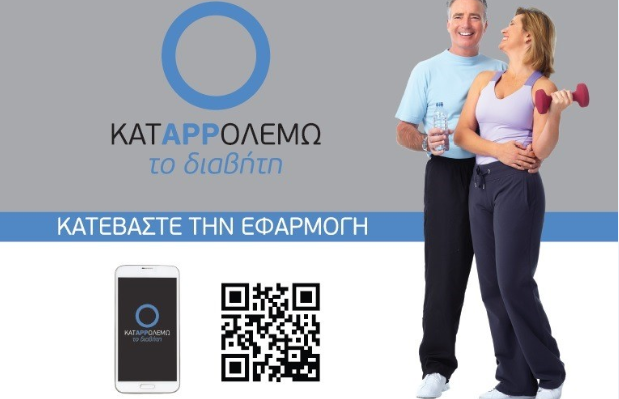
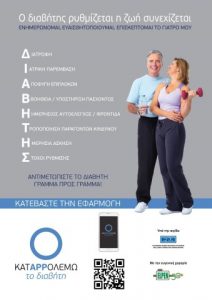 Το επιστημονικό σκέλος της εφαρμογής επιμελήθηκε ο Παθολόγος – Διαβητολόγος, Δρ Ιωάννης Ντούπης με τα επιμέρους θέματα να αναπτύσσονται από έγκριτους επαγγελματίες υγείας και να περιλαμβάνουν τόσο νεότερα δεδομένα σχετικά με τη θεραπεία του διαβήτη όσο και συμβουλές για τη βελτίωση του τρόπου ζωής των ατόμων με Διαβήτη. Η εφαρμογή «Κατappολεμώ το Διαβήτη» εγκαθίσταται εύκολα, γρήγορα και δωρεάν σε περιβάλλον android και iOS.
 Ο κ. Παπάνας αναφέρθηκε στους λόγους της συνεχούς αύξησης του Σακχαρώδους Διαβήτη τύπου 2, παγκοσμίως και στην Ελλάδα σημειώνοντας ότι «οφείλεται κυρίως στην καθιστική ζωή, την έλλειψη άσκησης και την παχυσαρκία. Αυτός ο τρόπος ζωής τα τελευταία χρόνια έχει υιοθετηθεί και από παιδιά και εφήβους, γεγονός που αυξάνει τον κίνδυνο ανάπτυξης Διαβήτη σε ολοένα μεγαλύτερο αριθμό ατόμων. Η διάγνωση πρέπει να γίνεται έγκαιρα, γιατί με την εφαρμογή της δίαιτας και της κατάλληλης θεραπείας μπορούν τα άτομα με Διαβήτη μακροπρόθεσμα να αποφύγουν ή να ελαχιστοποιήσουν τις προοδευτικές βλάβες στα όργανα του σώματος (π.χ. μάτια, πόδια, καρδιά, νεφρά κλπ)» ενώ συμπλήρωσε ότι με την κατάλληλη ρύθμιση «μπορούμε να αποφύγουμε ή να μειώσουμε τις χρόνιες επιπλοκές, να μειώσουμε τις μέρες νοσηλείας και να αποτρέψουμε την πρόωρη απώλεια ζωής».
 Ο κ. Ντούπης αναφερόμενος στην ψηφιακή εφαρμογή «Κατappολεμώ το Διαβήτη», τόνισε ότι «ήρθε για να καλύψει μια ανεκπλήρωτη ανάγκη της εποχής μας, που αφορά την εκπαίδευση των ασθενών σε θέματα που αφορούν την καθημερινότητα με το Διαβήτη όπως τη διατροφή και την άσκηση, τις θεραπείες, τις επιπλοκές, τον τρόπο φροντίδας των ποδιών και των δοντιών, τη σημασία της επίτευξης των στόχων θεραπείας, την αξία του αυτοελέγχου και της αποφυγής του καπνίσματος» και εξέφρασε την πεποίθηση ότι «θα αποτελέσει ένα εύχρηστο εργαλείο στα χέρια όλων των ατόμων με Διαβήτη τύπου 2. Με την επιμόρφωση και τις κατευθύνσεις που δύναται να παρέχει προς τους ασθενείς, σε συνδυασμό με τη στενή Ιατρική παρακολούθηση, θα συμβάλει στην επίτευξη των εξατομικευμένων στόχων κάθε ασθενούς, με απώτερο σκοπό την αποφυγή των επιπλοκών του Διαβήτη και τη βελτίωση της ποιότητας της ζωής».